
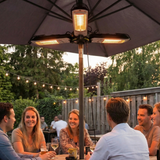
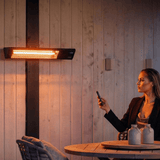

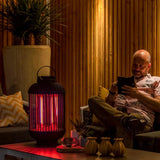
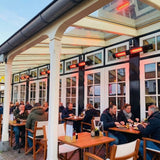
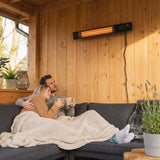
Hanging patio heater
A hanging patio heater is a smart choice if you have limited space under your awning, veranda, or pavilion but still want to stay comfortably warm. This collection is designed for areas where you want heat to come from above without having a freestanding model in the way. We will help you choose based on your space, installation options, and desired level of warmth. Still unsure about power or the type of heater? Use the selection guide below.
Choosing a patio heater?
Take the short quiz and find the perfect patio heater for your needs.
Filters
Hanging Heater 1500W - Heatix Patio Heater
- Light experience: Atmospheric warm light
- Coverage: 12–14 m²
- 3 positions
Shade Hanging Patio Heater 2000W with LED - Heatix
- Lots of light
- 8–18 m²
- 3 positions
Hanging Patio Heater with LED Lighting 2100W
- Lighting experience: Atmospheric warm light
- 10–20 m²
- 3 positions
Compact Artix Bright Hanging Black 1500 Watt
- Light amount: High
- Range: 12–14 m²
- 3 positions
Compact Artix Bright Hanging White 1500 Watt
- Light amount: High
- Range: 12–14 m²
- 3 positions
Indus Bright Hanging Black 2100 Watt
- Light amount: High
- 10–20 m²
- 3 positions
Heatix Smart Golden Shadow Hanging Heater 2000W
- Lighting experience: Low light
- 10–20 m²
- 9 settings
Heatix Smart Golden Shadow Hanging Heater 2500W
- Lighting experience: Low light
- 15–25 m²
- 9 settings
Heatix Smart Golden Shadow Hanging Heater 3000W
- Lighting experience: Low light
- 20–30 m²
- 9 settings
Heatix Smart Carbon Fiber Hanging Heater 2000W
- Lighting experience: Warm, atmospheric light
- 10–20 m²
- 9 settings
Heatix Smart Carbon Fiber Hanging Heater 2500W
- Lighting experience: Warm, atmospheric light
- 15–25 m²
- 9 settings
Heatix Smart Carbon Fiber Hanging Heater 3000W
- Lighting experience: Warm, atmospheric light
- 20–30 m²
- 9 settings
Why choose a hanging patio heater?
A hanging patio heater is particularly interesting if you want to add warmth without taking up extra space on the floor or wall. This makes this type of heater popular for pergolas, verandas, pavilions, and compact seating areas. You hang the heater above the table or seating area, directing the heat downwards to where you are sitting.
For many people, that is immediately the biggest advantage: the heater is out of the way and often fits nicely into the layout. Especially if you have just invested in a pergola, you don't want loose solutions that look cluttered or take up valuable space.
- No base or stand on your patio
- Suitable for compact and sheltered spaces
- Heat from above on your seating area
- Often easy to hang from the ceiling or beam
- Convenient if wall mounting is not possible or not practical
A hanging model is therefore particularly suitable when the location is the main factor. If you are looking for maximum power in a larger or open space, a wall-mounted patio heater can in many cases be more powerful and provide more targeted heat.
For what situations is a hanging heater suitable?
Under a pergola
Under a pergola is the most common situation. Under a pergola, you benefit from protection against the wind, and the heat escapes less quickly than on an open patio. A hanging patio heater works well here, especially above a dining table, lounge set, or compact seating area. Do you have a rectangular seating area against the wall? Then a wall-mounted model is often more logical. Are you sitting more centrally under the roof and don't want a heater in your line of sight from the side? Then a hanging model is a neat solution.
Under a veranda
A hanging heater also works well under a veranda, especially if you have a fixed seating area. Think of a table with four to six chairs or a small lounge area. Pay extra attention to the mounting height here. If the heater is hung too high, you will lose much of the sensation of direct warmth. If it is hung too low, it can be disruptive at the table or in the walkway.
In a pavilion or party tent
A hanging patio heater is also often chosen for a pavilion or temporary shelter. In that case, convenience is the main consideration: hang it up, connect it, and get immediate warmth where you are sitting. Lighter models are often chosen for this type of use, but the protection provided by the fabric or roof remains important for the sensation of warmth.
On an open patio
On a completely open patio, a hanging heater is usually less practical. The heat blows away more quickly, and you have less ceiling area to retain the heat. It can still work above a small table in a sheltered corner, but expect less effect than under a pergola. For more power in open spaces, many people prefer a standing or wall-mounted model. In that case, also consider a standing patio heater if you do not want a fixed installation.
For hospitality
For hospitality, a hanging heater can be interesting under verandas, awnings, or covered patios where walkways must remain clear. In that case, not only warmth is important, but also the position of tables, free passage, and the mounting points in the ceiling. For larger patios, multiple heaters are often more logical than one heavy model in the middle.
The main advantages of a hanging patio heater
1. You keep the floor clear
This is often the main reason for choosing a hanging model. No stand between the chairs, no cable across the floor, and no extra object in your seating area.
2. A nice solution for central seating areas
If you are sitting in the middle under the pergola, wall mounting is not always convenient. A hanging heater can then hang exactly above the spot where you want to feel warmth.
3. Direct warmth where you are sitting
Electric patio heaters provide warmth quickly. With a hanging model, you will notice this especially if the heater is hung at the right height above the table or seating area.
4. Suitable for different styles
There are functional models, models with limited glow, and models that provide a bit more atmosphere. Therefore, there is a suitable choice for both a sleek pergola and a more decorative veranda.
What should you pay attention to when buying?
Wattage: how much power is suitable for your space?
Wattage says something about the power of the heater, but not everything. The right choice depends on shelter, mounting height, and the distance to the seating area. However, you can roughly categorize it:
- 1500 watts: suitable for smaller and more sheltered spaces, such as a compact table or small seating area
- 1800 watts to 2000 watts: a good middle ground for standard use under a veranda or smaller pergola
- 2100 watts to 2500 watts: interesting if you want to feel more warmth, have a slightly larger seating area, or more open sides
- 3000 watts and higher: mainly for larger, more open, or commercially used spaces, provided the power supply and installation allow it
We advise not to look only at the power, but especially at the hot zone and the maximum range of the model. The hot zone is the area where you really clearly feel the warmth. The maximum range indicates how far the warmth still reaches. That combination helps you choose.
Mounting height: lower is not always better, higher neither
A common mistake is hanging the heater too high. Then it seems like a neat solution on paper, but in practice you feel less warmth. If you hang it too low, it can be disruptive above the table or come too close to people's heads. Therefore, always look at the recommended mounting height of the model. This varies by type. For a compact hanging heater for a table, it is often lower than for a more powerful model for a larger seating area.
Distance to the seating area
The distance between the heater and the user strongly determines how warm it feels. A heater hanging directly above the edge of the table gives a different effect than a heater hanging exactly above the center of the seating group. Therefore, think beforehand about how you actually sit: do you mainly eat at the table, or do you sit back in a lounge area?
Number of circuits and power supply
This point is often underestimated. Especially with heavier models or multiple heaters under one pergola, it is smart to check beforehand how many circuits are available. A heavier model places more demands on the power supply. If you use multiple heaters at the same time, a good distribution is important. If you are unsure about this, it is wise to first check your power point, fuse, and planned layout. This way you avoid choosing a heater that is powerful enough but not practically connectable to your situation.
Hanging, wall-mounted, or standing: what fits better?
Hanging versus wall-mounted
A hanging heater is strong in compact, central spaces. A wall-mounted model is often better if you want to radiate heat directly from one side to your seating area. Wall-mounted models are also popular if you want more choice in higher power and a tighter direction of the heat.
Choose hanging if:
- you want to keep the floor clear
- you are sitting centrally under the pergola
- you do not have a suitable wall position
Choose wall-mounted if:
- you want maximum targeted warmth
- your seating area is against or in front of a wall
- you want more choice in powerful fixed models
Hanging versus standing
A standing heater is more flexible because you can move it. The downside is that it takes up space and is more visible. A hanging model is more discreet and better if you have a fixed layout.
Practical examples from common situations
Situation 1: small pergola with dining table
You have a pergola with a table for four people. You mainly want to stay outside longer on cool evenings and do not want a heater on a stand between the chairs. In this situation, a hanging model is often a logical choice. Especially if the table is central and you want to feel warmth from above on the seating area.
Situation 2: lounge area with open side
You do have a roof, but one or two open sides. Then you lose warmth more quickly. A hanging heater can still work, but often one step higher in power is smart. If you are sitting close to a back wall, a wall-mounted model can even fit better because it radiates more directly.
Situation 3: veranda at a wooden house
Many people wonder if a heater can be attached to a wooden structure. It can, provided you follow the mounting instructions of the model and keep sufficient distance from the ceiling, beams, and other materials. That is precisely why the right bracket, height, and free space around the heater are important.
Situation 4: hospitality under an awning
You want to keep tables warm without blocking walkways. Then a hanging solution can be practical, especially for smaller tables in a covered part of the patio. For larger areas, a plan with multiple units is usually more powerful than one central model.
Differences between models and types
With or without adjustable heat settings
An adjustable heater gives more control. That is convenient if you do not always need full power. Especially in sheltered spaces, it is nice if you can switch between settings.
More or less visible glow
One user mainly wants power, the other wants less light under the pergola. There are models with more visible glow and models that look more discreet. Choose what fits your space and how you use the heater: functional, atmospheric, or a combination of both.
Operation on the device, with a remote control, or smart
For a heater above a table, operation on the device is not always the most convenient. Then a remote control or smart operation is more pleasant. Especially if the heater is hung higher, you will quickly notice that convenience in daily use.
How we help you choose
Are you torn between 1500W, 2000W, or 2500W? Or are you not sure if hanging really fits your pergola? Then we prefer to help you choose based on your space rather than just on specifications. Use our selection guide via. This will help you find a heater that fits your installation, seating area, and desired warmth more quickly. If you still cannot decide, you can also ask for personal advice. A photo of your pergola, veranda, or patio often helps to think along with you in a targeted way.
Frequently asked questions about a hanging patio heater
Is a hanging patio heater suitable for under every pergola?
Not always. It depends on the mounting height, available mounting, and how sheltered the space is. Under a compact or medium-sized pergola, it often works well. In an open space, another type may fit better.
How do I know what wattage I need?
Do not look only at the wattage, but also at the hot zone and the maximum range. Also pay attention to wind, open sides, mounting height, and the distance to your seating area. If in doubt, the selection guide is the fastest route.
Can I hang a hanging heater above a table?
Yes, that is precisely a frequently chosen application. Just make sure the heater is hung at the right height and that the warmth is directed at the people at the table, not too high above them.
Is a hanging model better than a wall-mounted model?
Not necessarily. A hanging model is especially convenient if you are sitting centrally and want to keep the floor clear. A wall-mounted model is often stronger in targeted warmth from one side. What is better depends on your space.
Can I combine multiple hanging heaters?
Yes, especially on wider pergolas or in hospitality, that can be sensible. Then pay close attention to the distribution of the warmth, the power supply, and the number of available circuits.
Conclusion: does a hanging patio heater fit your space?
A hanging patio heater is a strong choice if you want to sit noticeably warm under your pergola or veranda without losing space on the floor. Especially with a fixed table or compact seating area, this is often a neat and practical solution. Are you unsure about power, height, or type? Then use the selection guide and see which heater really fits your space. This way you choose correctly in one go and order with more certainty.


