
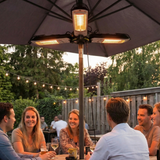
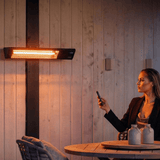
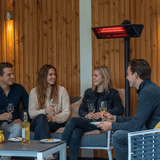
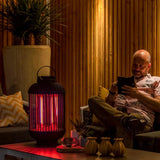
Commercial patio heaters
Choosing a patio heater?
Take the short quiz and find the perfect patio heater for your situation.
Filters
Heatix Smart Carbon Fiber Heater 3000W
- Lighting experience: Atmospheric warm light
- 20–30 m²
- 9 positions
Heatix Smart Carbon Fiber Heater 2500W
- Light experience: Atmospheric warm light
- 15–25 m²
- 9 positions
Heatix Smart Carbon Fiber Heater 2000W
- Lighting experience: Atmospheric warm light
- 10–20 m²
- 9 positions
Heatix Carbon Rose Gold Heater 1500W
- Light Experience: Low light
- 5–15 m²
- 3 positions
Hanging Patio Heater with LED Lighting 2100W
- Lighting experience: Atmospheric warm light
- 10–20 m²
- 3 positions
Hanging Heater 1500W - Heatix Patio Heater
- Light experience: Atmospheric warm light
- Coverage: 12–14 m²
- 3 positions
Heatix Standing Carbon Rose Gold Heater (1500W / 2000W / 2500W)
- Light perception: Poor light
- 3 positions
Heatix Standing Golden Shadow Heater (2000W / 2500W)
- Light perception: Poor light
- 9 positions
Heatix Standing Smart Carbon Fiber Heater (2000W / 2500W)
- Light experience: Atmospheric warm light
- 9 positions
Which hospitality patio heater is right for your terrace?
A good hospitality patio heater must do one thing above all: keep guests quickly and noticeably warm where they are sitting or standing. That sounds simple, but in practice, it depends on your situation. A sheltered terrace under a canopy requires a different heater than an open terrace on the street. That is why we look not only at wattage, but especially at location, installation, and how the heat reaches your guests. For most hospitality terraces, electric models are the most practical choice. They can be set up immediately, are easy to install, and are suitable for fixed heating zones. This is especially convenient for terraces with multiple tables: you heat specifically where people are sitting, instead of losing heat to the surrounding area.
Main benefits of an electric hospitality patio heater
- Immediately noticeable warmth: especially pleasant when guests arrive or when tables are used intermittently.
- Targeted heat: you can heat seating areas, walkways, or waiting areas separately.
- Fixed installation possible: neatly mounted on a wall or ceiling, without loose devices on the terrace.
- Adjustable: convenient for busy and quiet times.
- Fairly comparable: you choose based on hot zone, maximum range, and placement, not just power.
Are you mainly looking for fixed installation along the facade or under an awning? Then also check out our collection of wall-mounted patio heaters.
Applications: from canopy to open hospitality terrace
Under a canopy or awning
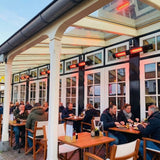
Under a canopy is often the easiest situation to heat well. The heat stays better, and you can direct the heater towards tables or a sofa arrangement. Here, many business owners choose wall or ceiling mounting. A model with a less intrusive glow can be pleasant if atmosphere and appearance are important. In a sheltered spot, comfort is often more important than maximum distance. Therefore, pay close attention to the hot zone: that is the zone in which guests can really clearly feel the heat. The maximum range is broader, but less intense. Both values together give a fairer picture of what you can expect.
Veranda or semi-open terrace
A veranda or semi-open terrace falls somewhere between sheltered and open. There is some protection, but drafts and side winds still play a role. In such a situation, a more powerful wall model often works better than a light model at a great height. If the heater is hung too high, you lose a lot of effect before the heat reaches the table. Does your veranda have multiple seating areas? Then two smaller heaters are often smarter than one large one. You distribute the heat better and prevent one corner from being warm while the other side is left behind.
Open terrace
On an open terrace, heat loss is the biggest challenge. Direct, powerful radiant heat is needed there. Especially if tables are exposed to the wind or if guests are not sitting under a canopy, a compact but powerful model often has more effect than a wide model with soft heat. For open terraces, we usually advise thinking in zones. Heat the tables you actually use, the row along the facade, or the waiting line at the entrance. That is not only more practical, but also gives guests the feeling that the terrace feels pleasant more quickly.
Freestanding setup or flexible terrace
Does your terrace layout change regularly? Then a freestanding model can be useful. Think of a temporarily expanded terrace, a seasonal setup, or a space that is used differently during the day than in the evening. In that case, you can also look at our freestanding patio heaters.
Buying advice: how to choose the right power
The right wattage depends on shelter, installation height, and distance to the guests. Looking only at high power is not enough. A heater that is too light gives too little effect, but a heater that is too powerful in the wrong place does not solve that.
Guideline for sheltered hospitality setups
- Sheltered under a canopy: often a mid-range to powerful heater is suitable.
- Semi-open veranda: choose one step more powerful, especially with open sides.
- Open terrace: here a powerful model with direct heat is generally needed.
In practice, wall models of 2500 watts are often a safe choice for many hospitality situations. They combine noticeable warmth with a useful range. For larger or more open terraces, 3000 watts is increasingly coming into view, especially if the installation height is a bit higher or if the distance to the table is greater.
Hot zone and maximum range
We always refer to heat in two ways: the hot zone and the maximum range. The hot zone is the place where guests can really clearly feel the heat. The maximum range shows how far the radiation still reaches, but there the heat is less intense. This difference is especially important for hospitality. You want to know where it is comfortable to sit, not just how far the heater technically radiates.
Installation height, distance, and direction
Installation height
The right installation height makes a big difference. If a heater is hung too low, the heat can feel too intense. If it is hung too high, you lose effect before the heat reaches the guests. Many hospitality setups come out to a height of approximately 2.1 to 2.5 meters, depending on the model and radiation angle. Always check the product specifications of the chosen model.
Distance to table or seating area
Not only the height, but also the horizontal distance counts. A heater that is hung too far from the table mainly heats the space in between. That is why placing it diagonally towards the seating area often works better than directly downwards at a great distance.
Direction of the heat
Think from the guest's perspective. Where do people really sit? Where do they wait? Where does the terrace turn inward or outward? A heater that is well aimed feels stronger than a more powerful model that hangs too generally.
How many circuits do you need?
In hospitality, the power supply is often just as important as the heater itself. One powerful heater can already use a significant part of a power circuit. Especially if lighting, refrigeration, or other equipment is on the same circuit, you want to look carefully at the load beforehand.
- Do not use heavy heaters together on one existing circuit without checking.
- Preferably distribute larger terraces over multiple heating zones.
- For multiple heaters, choose a logical switching scheme per facade, section, or row of seating.
- If in doubt, have an installer look at the available circuits.
For business owners with multiple zones or changing occupancy, smart models can be interesting. With them, you switch more specifically per zone. For that, also check out our collection of smart patio heaters.
Comparison of different types of hospitality patio heaters
Wall models
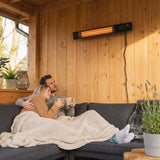
Wall models are the most logical choice for many hospitality businesses. They are fixed, take up no floor space, and are easy to aim at tables. Especially under canopies, on facades, and on verandas, they excel in comfort and control.
Ceiling or hanging models
Ceiling or hanging wall models are useful if wall space is limited or if you want to position the heat more centrally above a group of tables. They do require extra attention to height and range. If the model is hung too high or too centrally, the heat becomes less targeted.
Freestanding models
Freestanding heaters provide flexibility. That is useful for a terrace that changes often, but fixed installation usually remains neater and more predictable in use. For a hospitality environment with a lot of foot traffic, it is also pleasant if the floor remains free.
Practical scenarios
Scenario 1: small terrace along the facade
You have a narrow row of tables directly along the building. In that case, one or more wall heaters often work better than a freestanding model. Mount the heaters aimed at the row of tables, so that the hot zone falls exactly where guests are sitting.
Scenario 2: covered terrace with open side
This is a common situation. There is shelter above, but the side remains sensitive to wind. Here, preferably choose a more powerful model than you would for a fully sheltered canopy. Aim the heater slightly diagonally towards the seating area, so that the heat does not fall away on the open side.
Scenario 3: larger terrace with multiple zones
For a large terrace, it is rarely smart to want to solve everything with one type and one setting. Work with zones: for example, the facade side, the middle section, and the entrance. That way, you only turn on what is needed and the heat remains better distributed.
Scenario 4: terrace under a veranda with a focus on atmosphere
If your terrace is mainly about longer seating times and appearance, then a model with a calmer heat image is often nicer than just maximum brightness. Then pay attention to a heater that fits the atmosphere of the space, without compromising on noticeable warmth at the seating area.
What else do you pay attention to when comparing?
- Mounting form: wall, ceiling, hanging, or freestanding.
- Protection against moisture: important for semi-open or unsheltered terraces.
- Light output: more noticeable on open terraces, calmer desired under canopies.
- Operation: switch, remote control, or smart per zone.
- Maintenance and accessibility: useful for daily use in hospitality.
Choice aid for your situation
Are you undecided between 2500 watts or 3000 watts, wall or hanging, one heater or multiple zones? Then we help you choose based on your location. Use our choice aid for patio heaters or send us a photo of your terrace. Then we will look at the installation height, shelter, and the smartest setup for your situation.
Frequently asked questions about hospitality patio heaters
Which hospitality patio heater is best for an open terrace?
For an open terrace, direct, powerful heat is especially important. Choose a model that performs well in the wind and pay attention to a clear hot zone, so that the heat really remains noticeable at the seating area.
Is a wall model better than a freestanding model?
For many hospitality businesses, yes. A wall model saves space, is fixed, and is easy to aim at tables or walkways. A freestanding model is especially useful if your setup changes often.
Is one heater enough for my terrace?
That depends on the width of the terrace, the shelter, and the layout. For multiple tables or a longer facade, two well-placed heaters are often more effective than one large model in the middle.
Which installation height is suitable?
That varies per model, but many heaters are placed at a height where the heat falls directly on the seating area without feeling too intense. Always check the recommended installation height of the product itself.
How do I choose between 2500W and 3000W?
2500W is a strong, practical choice for many hospitality terraces. 3000W is often more interesting for more open situations, higher installation, or a greater distance to the guests. Undecided? Then looking at your location is more important than just the number.
Conclusion: choose based on your location, not just power
The right hospitality patio heater ensures that guests stay seated comfortably longer at exactly the place you want to heat. Therefore, do not look only at wattage, but especially at shelter, installation height, hot zone, and the number of zones on your terrace. That way, you choose a heater that really fits your business. Want to quickly know what works for your situation? Then use the choice aid or contact us for personal advice.


