

3,000 watts
A 3000-watt patio heater is designed for those who need extra warmth under a canopy, on a veranda, or on a more open patio. In this collection, you’ll find powerful electric heaters suitable for larger seating areas and situations where 2000 or 2500 watts may not be enough. We’ll help you choose based on your space, installation options, and desired level of warmth.
Filters
Heatix Smart Golden Shadow Heater 3000W
- Light perception: Low light
- 20–30 m²
- 9 positions
Heatix Smart Carbon Fiber Heater 3000W
- Lighting experience: Atmospheric warm light
- 20–30 m²
- 9 positions
Heatix Smart Carbon Fiber Hanging Heater 3000W
- Lighting experience: Warm, atmospheric light
- 20–30 m²
- 9 settings
Heatix Smart Golden Shadow Hanging Heater 3000W
- Lighting experience: Low light
- 20–30 m²
- 9 settings
Why choose a 3000-watt patio heater?
You don't choose a 3000-watt patio heater because the number sounds impressive, but because your space needs more power to get truly warm. Think of a wide awning, a veranda with many open sides, an open patio, or a hospitality venue where guests are not sitting close to the heater. While lower power levels often work perfectly in a compact, sheltered seating area, 3000 watts provides more reserve. You'll notice this especially if the heater is hung higher, the space is more open, or you want to distribute heat over a wider area.
The main benefits
- More noticeable warmth in larger or less sheltered spaces
- Better suited for higher installation under an awning or veranda
- Greater width coverage at a dining table or lounge area
- Suitable for those who want maximum heat and are unsure if it will get warm enough
- Often adjustable with multiple heat settings or smart controls
We always talk about heat honestly: don't just look at the wattage, but especially at the hot zone and the maximum range of the model. This will help you better understand what to expect in your space.
For which situations is 3000 watts a good choice?
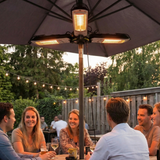
Under an awning
Under an awning, 3000 watts is often appealing if you have a wider seating area or if the heater needs to be hung a little higher. Extra power can be particularly useful for deep awnings or wide dining tables. You'll be less likely to need two lighter models, although that may still be the smarter choice in some setups. Do you mainly have a fixed setup against a wall? Then also check out our wall-mounted patio heaters. That is the most popular solution for many awnings.
On a veranda
A veranda is often somewhere between indoors and outdoors. It offers shelter, but not always complete protection. This makes 3000 watts attractive if you want to spend longer evenings there and clearly feel the warmth. You'll especially notice the difference between enough and just not enough when there is an open front or drafts from the side.
On an open patio
An open patio demands more from a heater. Heat loss is greater here because there is less shelter. A 3000-watt patio heater is therefore more logical than a lighter model, although placement remains particularly important. Direction, mounting height, and wind make a big difference here. On an open patio, one powerful heater may be enough for a compact zone, but for a wider setup, two heaters may work better than one. Not because you want to stack more watts without a plan, but because the heat will be distributed more evenly.
For hospitality
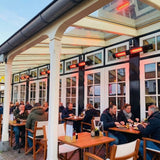
For hospitality, 3000 watts is often a serious starting point, especially on a patio where guests are spread out and you need reliable, noticeable warmth. Power is not the only important factor; placement above tables, walkways, and seating areas matters too. That is why we always look beyond the product itself when considering hospitality.
How much heat can you expect?
A 3000-watt patio heater is designed for situations where clear radiant heat is needed. However, 3000 watts does not tell the whole story. A compact model that is hung low and focused feels different from a model that needs to radiate higher and wider.
Therefore, always pay attention to these two points:
- Hot zone: the area in which you feel the warmth most clearly
- Maximum range: the outermost boundary where warmth can still be felt
This is much more useful for your choice than a general claim about surface area. Especially outdoors or under a semi-open awning, the outcome varies greatly depending on the situation.
Buying advice: what should you look out for?
1. Wattage: when is 3000 watts a smart choice?
3000 watts is especially smart if you find that your situation requires just a little more than a standard 2000- or 2500-watt wall heater. For example if:
- your heater needs to be hung higher
- your patio is partially open
- you want to heat a wide table or lounge area
- you deliberately choose more heat security
Do you have a compact, well-sheltered space directly under a low awning? Then a lower wattage may still be perfectly suitable. In that case, you could compare it with a 2500-watt patio heater.
2. Mounting height
Mounting height has a major impact on how warm it feels. The higher a heater is hung, the greater its range can be, but the less intense the heat feels directly at the seating area. That is why 3000-watt models are often chosen when the heater cannot be hung low. Always check the specified minimum and maximum mounting height of the model. This will prevent disappointment after installation.
3. Distance from the seating area
A heater works best when the radiant heat can properly reach your seating area. If the heater is hung too far away, you will lose comfort. If it is hung too close to the users, the heat will become too concentrated. The right distance is therefore a balance between comfort, safety, and coverage.
4. Number of circuits
With 3000 watts, the electrical connection becomes particularly important. In many situations, you want to know in advance whether your circuit, socket, and cabling are suitable for the chosen model. Especially if you want to install multiple heaters, you need to carefully consider how they are distributed across circuits.
We recommend checking the following before purchase:
- whether there is a free circuit available
- whether you want to connect one or multiple heaters
- whether the area is directly accessible with power
- whether fixed installation or plug use is the most logical choice
If you are unsure about this, we would rather help you beforehand than afterwards.
Differences between models and types
Wall, ceiling, or hanging
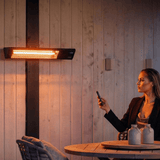
Most visitors in this collection are looking for a fixed solution under their awning. In that case, a wall-mounted model is often the first choice. You can mount it to focus on the seating area, ensuring the heat reaches where you are sitting. Ceiling-mounted or hanging models are useful if wall mounting is not possible or if you want to heat a more central area. Keep in mind, however, that a hanging heater often radiates differently from a focused wall-mounted model.
With or without smart controls
Some 3000-watt models have a remote control, timer, or app control. This is especially useful if the heater is hung high or if you want to switch quickly between different heat settings. Smart controls are convenient, but not always necessary. If you are mainly looking for simplicity, a model with fixed or limited controls may be preferable.
More or less visible glow
Not everyone wants the same look. Some are looking for pure power, while others want less visible light under the awning. Therefore, it is worth looking at the type of element and the light output. If you choose a less visible glow, you may sometimes compromise on direct heat perception or price. That is also part of choosing honestly.
Practical examples
Scenario 1: wide awning with a fixed dining table
You have an awning with a wide table for six people. The heater is located on the back wall and must radiate over the table. In such a case, 3000 watts is often logical, because you need enough power to remain noticeably warm across that depth. A model with multiple settings is then useful, so you do not always have to use full power.
Scenario 2: veranda with an open front
Your veranda is reasonably sheltered on three sides, but the front is open. This means you lose heat more quickly. A 3000-watt heater provides more certainty here than a lighter model. Do pay attention to the direction of the heater: pointing it directly at the seating area often works better than mounting it high and flat without an angle.
Scenario 3: open patio at a home or hospitality venue
On an open patio, the question is often not only how much power you need, but also how many heaters. One 3000-watt heater can create a clear heat zone, but for a wider setup, distribution is more important than peak power alone. Two well-placed heaters may therefore be more comfortable than one central heater.
When is it better not to choose 3000 watts?
More power is not automatically better. In these situations, a lower wattage may be more logical:
- you have a small, well-sheltered seating area
- the heater is hung relatively low and close to the users
- you are mainly looking for subtle supplementary heat
- your electrical connection is limited
In that case, it is smarter to focus on a lower power level or a different type of heater. We would rather help you choose honestly than recommend something unnecessarily powerful.
How to make the right choice for your space
Do not start with the brand or the appearance, but with your situation. Ask yourself these questions:
- Where will the heater be hung: on a wall, from the ceiling, or hanging?
- How sheltered is the space really?
- How high will the installation be?
- How wide and deep is the seating area that needs to be heated?
- Do you need one heater or two models that are better distributed?
If you are not entirely sure, use our selection guide. You will see more quickly which type and power level suit your space.
Comparison: 3000 watts versus other choices
3000 watts versus 2500 watts
2500 watts is a strong middle ground for many awnings. 3000 watts comes into consideration if you have more openness, a larger seating area, or need to mount it higher. The difference seems small on paper, but in practice, it may make all the difference between pleasantly and convincingly warm.
3000 watts versus two lighter heaters
One 3000-watt heater is easy to manage and powerful. Two lighter heaters may be better if you want to distribute heat over multiple seating areas. Especially with a wide lounge or long table, distribution may be more important than one central heat source.
3000-watt wall-mounted model versus hanging model
A wall-mounted model is often more direct and focused. A hanging model is useful if you want to heat from the center or do not have a free wall. Which is better suited depends on your structure and where people are sitting.
Frequently asked questions about 3000-watt patio heaters
Is 3000 watts too powerful for an awning?
No, not necessarily. For a larger or more open awning, 3000 watts may be just right. It depends on the mounting height, the shelter, and the size of the seating area.
Is one 3000-watt patio heater enough?
It can be, but not in every situation. For a compact to medium-sized zone, one heater may be sufficient. For a wide setup or open patio, two heaters may work better together.
Is 3000 watts only suitable for hospitality?
No. 3000 watts is also frequently chosen for private use, especially under larger awnings and on verandas where people want to sit and feel noticeably warm.
Can I hang a 3000-watt heater myself?
That depends on the model, the mounting location, and the power supply. The mechanical installation may sometimes be perfectly manageable, but always check the manual and have the electrical work assessed if necessary.
How do I know which model is the best fit?
Look at your situation: shelter, mounting height, distance from the seating area, and desired warmth. If you are unsure, use the selection guide or send us a photo of your awning for personal advice.
Conclusion: powerful heat when your space calls for it
A 3000-watt patio heater is a strong choice if you need more than basic warmth. Especially under a larger awning, on a veranda with open areas, or on an open patio, this power level provides more certainty of noticeable warmth. Do not just look at the wattage, but especially at the hot zone, maximum range, and installation. View the models in this collection or use the selection guide directly, and we will help you choose what truly suits your space.


